

AI Trading Strategies: What Actually Works (And What Doesn’t)
By Kevin J. Davey - 3X World Cup Trading Champion | KJTradingSystems.com
Quick Summary
AI trading is powerful, but most traders use it incorrectly. The biggest issue is overfitting - models that look incredible in backtests but fail in live trading because they capture noise, not real edge. Complexity, excessive inputs, poor validation, and unrealistic expectations only make the problem worse. Tools like Claude and ChatGPT are best used for idea generation and research - not as shortcuts to profitable systems. The traders who succeed combine AI with a disciplined development process, rigorous testing, and simple, robust strategies. In the end, the edge doesn’t come from AI - it comes from the process used to build and validate strategies.
AI trading is powerful, but most traders use it incorrectly. The biggest issue is overfitting - models that look incredible in backtests but fail in live trading because they capture noise, not real edge. Complexity, excessive inputs, poor validation, and unrealistic expectations only make the problem worse. Tools like Claude and ChatGPT are best used for idea generation and research - not as shortcuts to profitable systems. The traders who succeed combine AI with a disciplined development process, rigorous testing, and simple, robust strategies. In the end, the edge doesn’t come from AI - it comes from the process used to build and validate strategies.
1. The Promise vs. Reality of AI Trading

I’ll be honest with you. When I first started hearing all the buzz about AI trading, my initial reaction was skepticism. Not because I’m some anti-technology curmudgeon - quite the opposite. I’ve been algo trading for over 30 years, and I jumped on board with mechanical systems long before they were fashionable. So when something new hits the trading world, I pay attention.
I remember similar “buzz” back in the early 1990s over “neural networks” – an AI tool before AI trading became fashionable. I (along with many others) jumped on that bandwagon, which promised unlimited wealth by using neural networks in trading.
Of course, that did not pan out quite as expected!
And wow, has AI trading gotten people’s attention. Just do a quick Google search for “AI trading strategies” and you’ll see what I mean. Thousands of articles, YouTube videos, courses and “systems” all promising you the same thing: finally, a smarter way to beat the market.
Tools like ChatGPT, Claude, Gemini and Grok have made AI accessible to just about everyone. You don’t need a PhD in data science anymore. You can describe a trading idea to an AI chatbot, ask it to write the code, paste that code into your platform, and have a backtest running in an hour. And the results? They look incredible after AI does its magic. Beautiful equity curves. Sharpe ratios you’d frame and hang on the wall. Win rates that would make any discretionary trader jealous.
Then they go live.
And that’s where the story always ends the same way. The beautiful backtest falls apart. The real-money results look nothing like what the model promised. Debilitating drawdowns appear out of nowhere. The account bleeds. Confidence evaporates. And the trader is left staring at their screen (and their brokerage statement) wondering what went wrong.
I’ve seen this cycle play out hundreds of times. I get e-mails from “victims” of these backtests all the time. And here is what I’ve concluded after watching it happen over and over: AI is genuinely powerful, but most people are using it completely wrong. They’re expecting AI to shortcut the hard work of proper strategy development. And you simply can’t shortcut that work. Trust me - I’ve tried.
This article isn’t an AI hit piece. I actually use AI in my own trading and teach my Strategy Factory Workshop students how to use it properly. It has legitimate, valuable applications. But “legitimate and valuable” and “push a button and get rich” are very different things.
Let’s break down what actually works - and what doesn’t.
I remember similar “buzz” back in the early 1990s over “neural networks” – an AI tool before AI trading became fashionable. I (along with many others) jumped on that bandwagon, which promised unlimited wealth by using neural networks in trading.
Of course, that did not pan out quite as expected!
And wow, has AI trading gotten people’s attention. Just do a quick Google search for “AI trading strategies” and you’ll see what I mean. Thousands of articles, YouTube videos, courses and “systems” all promising you the same thing: finally, a smarter way to beat the market.
Tools like ChatGPT, Claude, Gemini and Grok have made AI accessible to just about everyone. You don’t need a PhD in data science anymore. You can describe a trading idea to an AI chatbot, ask it to write the code, paste that code into your platform, and have a backtest running in an hour. And the results? They look incredible after AI does its magic. Beautiful equity curves. Sharpe ratios you’d frame and hang on the wall. Win rates that would make any discretionary trader jealous.
Then they go live.
And that’s where the story always ends the same way. The beautiful backtest falls apart. The real-money results look nothing like what the model promised. Debilitating drawdowns appear out of nowhere. The account bleeds. Confidence evaporates. And the trader is left staring at their screen (and their brokerage statement) wondering what went wrong.
I’ve seen this cycle play out hundreds of times. I get e-mails from “victims” of these backtests all the time. And here is what I’ve concluded after watching it happen over and over: AI is genuinely powerful, but most people are using it completely wrong. They’re expecting AI to shortcut the hard work of proper strategy development. And you simply can’t shortcut that work. Trust me - I’ve tried.
This article isn’t an AI hit piece. I actually use AI in my own trading and teach my Strategy Factory Workshop students how to use it properly. It has legitimate, valuable applications. But “legitimate and valuable” and “push a button and get rich” are very different things.
Let’s break down what actually works - and what doesn’t.
2. What Is AI Trading (or AI Algorithmic Trading)?
Before we go further, let’s get clear on what “AI trading” actually means. The term gets thrown around so loosely that it’s become almost useless as a descriptor.
At its core, AI trading means using artificial intelligence or machine learning techniques to generate, refine, or execute trading decisions. That’s different from traditional algorithmic trading - which I’ve done for decades - where every rule is explicitly programmed by a human. In traditional algo trading, you write: “If X happens, do Y.” You know exactly why every trade gets taken. The logic is transparent.
AI-driven systems flip that on its head. Instead of writing the rules yourself, you feed historical data to a model and let it discover patterns on its own. You’re not specifying the rules. The algorithm infers them. You might not even understand the rules it creates – not necessarily a bad thing, though.
Sounds amazing, right? In theory, it is. In practice, that’s where things get messy.
The Main Flavors of AI in Trading
Machine Learning (ML): The broadest category. ML algorithms learn from data without being explicitly programmed. In trading, you typically train a model on historical price data, volume, indicators, or other inputs to predict future direction or returns. Common approaches include decision trees, random forests, gradient boosting, and support vector machines.
Neural Networks and Deep Learning: Loosely inspired by the brain’s structure, these models process data through layers of interconnected nodes. Deep learning stacks many such layers, which can theoretically identify extremely complex, non-linear relationships. The processing power required is substantial. The potential for overfitting is even more substantial. (More on that in a minute.)
Reinforcement Learning (RL): A different animal altogether. An “agent” learns by taking actions and receiving rewards or penalties based on the results. In trading, it takes positions and receives profit or loss signals, gradually refining its approach. Theoretically interesting. Extremely difficult to implement robustly with real market data. I’d approach this one with caution unless you have a serious research background. And a serious trading background as well. Good researchers might not understand trading, and good traders might not understand good research. It takes both skills to succeed in this niche.
Why AI Feels So Powerful
Markets are complicated. Thousands of variables interact in ways no human analyst can fully track. AI can process enormous datasets and simultaneously evaluate dozens of inputs. That capability is genuinely impressive.
And we’ve all heard the success stories. Renaissance Technologies. Two Sigma. D.E. Shaw. These firms use sophisticated quantitative and AI-driven approaches, and they’ve minted money for decades.
Here’s the thing though. Those firms have armies of PhD researchers, billions in infrastructure, and proprietary processes built over decades. The “AI trading” you can put together from a ChatGPT conversation and a YouTube tutorial is a fundamentally different beast. Calling them both “AI trading” is like calling both a go-kart and a Formula 1 car “racing vehicles.”
Technically true. Wildly misleading.
At its core, AI trading means using artificial intelligence or machine learning techniques to generate, refine, or execute trading decisions. That’s different from traditional algorithmic trading - which I’ve done for decades - where every rule is explicitly programmed by a human. In traditional algo trading, you write: “If X happens, do Y.” You know exactly why every trade gets taken. The logic is transparent.
AI-driven systems flip that on its head. Instead of writing the rules yourself, you feed historical data to a model and let it discover patterns on its own. You’re not specifying the rules. The algorithm infers them. You might not even understand the rules it creates – not necessarily a bad thing, though.
Sounds amazing, right? In theory, it is. In practice, that’s where things get messy.
The Main Flavors of AI in Trading
Machine Learning (ML): The broadest category. ML algorithms learn from data without being explicitly programmed. In trading, you typically train a model on historical price data, volume, indicators, or other inputs to predict future direction or returns. Common approaches include decision trees, random forests, gradient boosting, and support vector machines.
Neural Networks and Deep Learning: Loosely inspired by the brain’s structure, these models process data through layers of interconnected nodes. Deep learning stacks many such layers, which can theoretically identify extremely complex, non-linear relationships. The processing power required is substantial. The potential for overfitting is even more substantial. (More on that in a minute.)
Reinforcement Learning (RL): A different animal altogether. An “agent” learns by taking actions and receiving rewards or penalties based on the results. In trading, it takes positions and receives profit or loss signals, gradually refining its approach. Theoretically interesting. Extremely difficult to implement robustly with real market data. I’d approach this one with caution unless you have a serious research background. And a serious trading background as well. Good researchers might not understand trading, and good traders might not understand good research. It takes both skills to succeed in this niche.
Why AI Feels So Powerful
Markets are complicated. Thousands of variables interact in ways no human analyst can fully track. AI can process enormous datasets and simultaneously evaluate dozens of inputs. That capability is genuinely impressive.
And we’ve all heard the success stories. Renaissance Technologies. Two Sigma. D.E. Shaw. These firms use sophisticated quantitative and AI-driven approaches, and they’ve minted money for decades.
Here’s the thing though. Those firms have armies of PhD researchers, billions in infrastructure, and proprietary processes built over decades. The “AI trading” you can put together from a ChatGPT conversation and a YouTube tutorial is a fundamentally different beast. Calling them both “AI trading” is like calling both a go-kart and a Formula 1 car “racing vehicles.”
Technically true. Wildly misleading.
3. Why Most AI Trading Strategies Fail
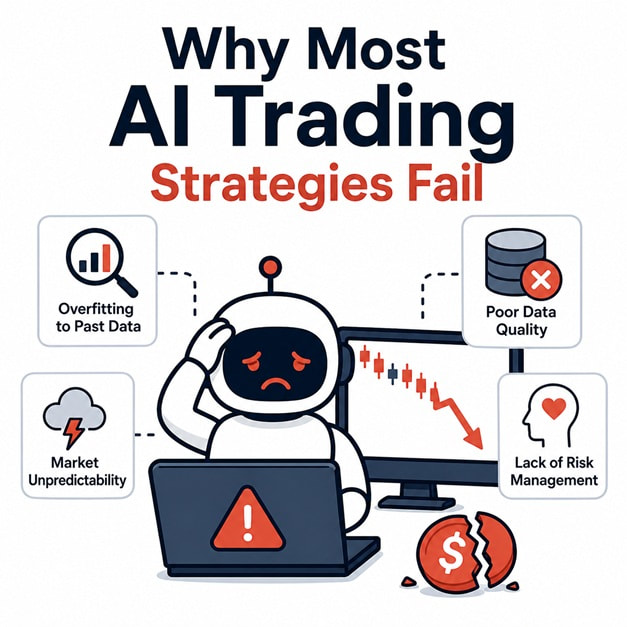
This is the section I really want you to read carefully. Because there are specific, well-understood reasons why AI trading strategies fail. They’re not mysterious. They’re not bad luck. And they have nothing to do with the quality of the AI tools themselves.
They have everything to do with how the tools get used.
3.1 Overfitting: The Silent Strategy Killer
In 30+ years of algo trading, I’ve reached the conclusion that overfitting has caused more account damage than any other single problem. I’ve lost money because of it. Students I’ve mentored have lost money because of it – until we eliminated it as an issue. And AI makes overfitting dramatically worse.
Here’s the basic idea. When you run a backtest, you’re fitting a model to a specific historical dataset. The model - whether it’s a set of rules or a neural network with a million parameters - learns to explain that specific sequence of prices. And here’s the problem: it doesn’t just learn the genuine, repeatable patterns. It also learns the noise. The random events. The one-time anomalies that will never happen in exactly that way again.
An overfit strategy is like a student who memorizes last year’s exam answers instead of actually learning the subject. They’ll ace the old test.
New test? They’re lost.
Here’s a typical scenario. A trader builds an ML model using 50 technical indicators as inputs. The model optimizes its parameters to maximize backtest returns over five years. The result looks spectacular: 82% win rate, Sharpe ratio of 4.1, virtually no drawdown. The trader is thrilled. They go live.
Six months later, the win rate is 44%. The drawdowns are deeper, longer and more painful than anything in the backtest. The strategy loses money consistently. The model learned nothing useful - it memorized history.
Why does AI make overfitting worse? Because AI models can have thousands or even millions of parameters. A neural network with enough layers can memorize an entire dataset without learning a single generalizable pattern. The training performance looks perfect. The real-world performance is a disaster.
KEY POINT: The more parameters your model has, the more capable it is of perfectly fitting past noise - and the less likely it is to work on future data. Complexity is the enemy of robustness.
3.2 False Pattern Discovery
Here’s something most people don’t fully appreciate: given enough data and enough computational power, you will always find patterns. Even in completely random data.
Flip a coin 10,000 times. You’ll find sequences that look meaningful. Seven heads in a row. Apparent cycles. Promising correlations. None of them are real. They’re statistical artifacts of random noise.
Markets are noisier than most traders realize. The signal-to-noise ratio in financial data is extremely low. When you run an AI model over five years of daily futures data, you’re working with roughly 1,250 data points. That’s not a lot for a model trying to discover stable, repeatable patterns across multiple market regimes.
AI is exceptionally good at finding patterns. It is not inherently good at distinguishing real patterns from noise. That distinction requires domain knowledge, rigorous testing methodology, and a healthy skepticism about results that look too good. Those are all human responsibilities. No AI model can substitute for them.
3.3 The Curse of Dimensionality
This one surprises a lot of traders, because the intuition seems backwards. Surely more inputs to my model means better predictions, right?
Wrong. And there’s a reason it’s called a “curse.”
Imagine you have 1,000 historical trades and you want to find patterns. With one input variable, you have decent coverage across its range. With two variables, you’re spreading 1,000 examples across a two-dimensional grid. By the time you have 20 input variables, you’ve scattered 1,000 data points across a 20-dimensional space that’s almost entirely empty. The model has to fill in those vast empty regions with something - and what it fills them in with is invented patterns.
Many traders build AI models with 30, 40, or 50 technical indicators. Every indicator they add gives the model more degrees of freedom to explain the historical data - which makes the backtest look better and inevitably makes the live performance worse.
The best algo trading models in my experience are surprisingly simple. Small number of carefully selected inputs. Clear economic rationale for each one (although sometimes I do stray from this principle, buy hey so did James Simons, the greatest algo trader of all time). The discipline of feature selection, rigorously deciding what goes into the model, matters more than any fancy architecture.
3.4 Market Non-Stationarity
Every ML model makes an implicit assumption: the future will look like the past. In financial markets, that assumption is never fully satisfied. Markets change.
Volatility regimes shift. Central bank policies change. Market microstructure evolves as electronic trading takes over. The participants change; high-frequency traders, ETFs, retail options traders, each with their own behavior patterns, arriving and departing over time.
A model trained on 2013–2018 data learned patterns that existed in a very specific environment: quantitative easing, low volatility, particular regulatory conditions. When the regime changed, strategies optimized for that environment often failed completely: not just underperformed, but failed.
Simple rule-based systems can often survive regime changes with moderate performance degradation. An aggressively overfit neural network may just stop working entirely.
3.5 The Black Box Problem
When a rule-based strategy stops working, you can diagnose it. The momentum signal is giving too many false signals in a sideways market. The exit is leaving too much profit on the table. You can find the problem, understand it, and make an informed decision about whether to fix it or retire the strategy.
When a neural network stops working, you’re often flying blind. The model is a function with potentially millions of parameters, and its internal logic isn’t human-interpretable. Did it break because of a regime change? A data quality issue? A coding bug? Or was the edge never real in the first place? Good luck figuring that out without transparency.
This matters enormously for your ability to manage drawdowns. If you can’t understand your strategy, you can’t have confidence in it during rough patches. And without that confidence, you’ll abandon good strategies too early and stick with bad ones too long.
3.6 Data Quality Issues
Garbage in, garbage out. That saying predates machine learning by decades, but it’s never been more relevant.
Common data problems that can torpedo an AI model: survivorship bias in historical datasets (only includes assets that survived, skipping the losers), look-ahead bias (using data that wasn’t available at trade time), poorly handled contract rollovers in futures data, price errors and outliers that skew training, and inconsistent handling of dividends and splits.
A simple rule-based strategy might be somewhat robust to these issues. An AI model will bake them deeply into its learned patterns, making them very hard to detect. Your backtest will look great. Your live trading will confuse you.
3.7 Unrealistic Expectations
I’ve been doing this for over 30 years. Here is what I can tell you about realistic trading performance: consistent annual returns of 20–30% with moderate drawdowns represent genuinely excellent results. World-class results. That will shock the 100% return per week fraudsters peddling garbage financial education, of course!
The idea that an AI algorithmic trading model you built over a weekend is going to produce 200% annual returns with a 5% max drawdown? That’s a fantasy – least in real time. In backtest, it is very possible. And it’s a dangerous fantasy. Because when traders chase those numbers in their backtests, they over-optimize. They skip validation steps because the preliminary results “already look great.” They size positions aggressively because their model has a “90% win rate.” And when reality inevitably disappoints, the damage can be severe.
The marketing around AI trading sets people up to fail. Unrealistic expectations lead to poor decisions, and poor decisions lead to losses.
4. Case Studies: Typical AI Algo Strategy Failures
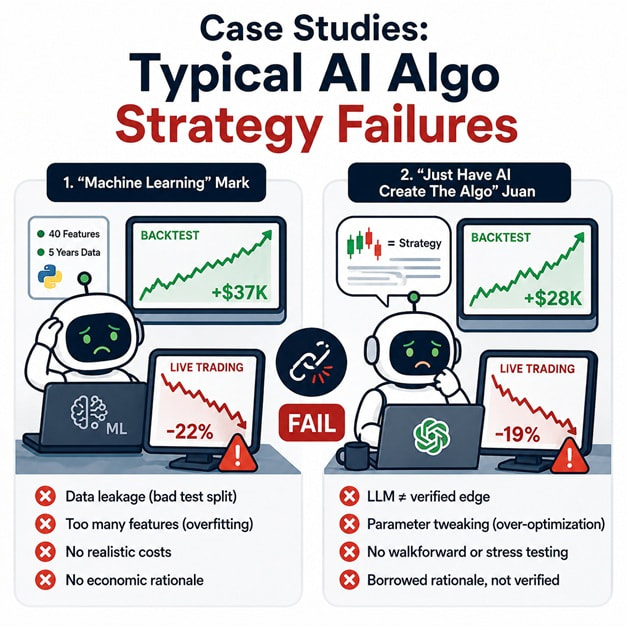
Let me walk you through scenarios I’ve seen play out many, many times. The names change. The markets change. The specific tools change. Yet the ending (sadly) never does.
Scenario – “Machine Learning” Mark
The Setup. A trader - let’s call him Mark - has been trading ES futures for three years. He’s heard the AI buzz and decides to build a trading strategy with AI. He watches some tutorials, installs Python, and gets to work.
Building the Model. Mark collects five years of daily OHLCV data for the ES. He engineers 40 features: every common technical indicator he can find, plus some custom combinations. He splits the data 80/20, trains a gradient boosting classifier to predict whether the next day’s close will be higher or lower than the open, and evaluates it on the test set.
Test set accuracy: 58%. Mark has read that anything above 55% is potentially tradeable (a totally false claim put forth by some), and 58% feels solid. He tunes his hyperparameters using cross-validation and gets the accuracy up to 61%.
The Backtest. Mark builds a simple backtest around his model’s signals. Long when up, short when down, close at end of day. Five-year result: $10,000 grew to $47,000. Annual return of roughly 36%. Maximum drawdown of just 12%. Sharpe ratio of 1.8.
Mark shows his friends. They’re impressed. He paper trades for two weeks, gets a few wins, decides he’s ready.
Going Live. Month 1: down 4%. Month 2: down 6%. Month 3: down 3%. Six months in, he’s down 22% and the strategy shows no signs of recovering.
What went wrong?
Failure #1: The train/test split was contaminated. Mark used cross-validation to tune his hyperparameters. That means his “test” set was used for optimization decisions, destroying its validity as a genuine out-of-sample evaluation. This is one of the most common and least understood mistakes in AI for trading.
Failure #2: Classic curse of dimensionality. Forty features on five years of daily data. The model found patterns that explained those 1,250 trading days with impressive accuracy — but those patterns were mostly noise.
Failure #3: No realistic transaction costs. The backtest used clean prices. Live trading involves slippage and commissions. Strategies that are borderline profitable in clean data can easily become losers with realistic fill assumptions.
Failure #4: No economic rationale. Mark never asked: why should this pattern persist? What market mechanism creates and sustains this edge? Without a logical foundation, there is no reason to believe that a pattern found in historical data will continue into the future. None.
Mark’s story isn’t unusual. It’s the norm. The backtest looked great because the model was inadvertently designed to make it look great. The live results reflected what the strategy actually was: a collection of noise patterns dressed up as alpha.
Scenario – “Just Have AI Create The Algo” Juan
Here's a different flavor of the same problem. Same ending, different route to get there.
The Setup. Juan has been trading crude oil futures for a couple of years. He's not a programmer, so the ML approach Mark tried isn't really his thing. But he's heard that ChatGPT can generate trading strategies, and that sounds a lot more accessible. He fires up his browser.
Getting the Idea. Juan types a pretty reasonable prompt: "Give me a profitable crude oil futures trading strategy using technical indicators. Include specific entry and exit rules I can backtest."
ChatGPT obliges immediately. It spits out a strategy using a 14-period RSI combined with a 50-period moving average crossover, with a fixed $1,500 stop loss and a 2:1 reward-to-risk profit target. Entry rules are clearly stated. Exit rules are clearly stated. It even throws in some confident-sounding language about how this "capitalizes on momentum while filtering out noise."
Juan is impressed. The strategy sounds logical. ChatGPT explained the rationale. It looks professional. He copies the rules into his trading platform and runs a backtest.
The Backtest. Five years of crude oil data. The results: $10,000 grew to $38,000. Annual return around 28%. Maximum drawdown of 18%. Win rate of 52%. Juan reads about the Sharpe ratio online and calculates it at 1.4. Not as flashy as Mark's results, but it still looks pretty darn good. He tweaks the RSI period from 14 to 11 and the moving average from 50 to 45. The return jumps to 34% and the drawdown shrinks to 14%. Even better.
He posts the equity curve in a trading forum. Positive reactions all around. Two weeks of paper trading with decent results. He goes live.
Going Live. Month 1: down 3%. Month 2: down 7%. Month 3: roughly breakeven, but only because one lucky trade bailed him out. Month 4: down 5%. Six months in, he's down 19% and nothing about the live trading feels anything like the backtest.
What went wrong?
Failure #1: ChatGPT has no idea if the strategy actually works. This is the one people miss. LLMs are text prediction engines. They generate plausible-sounding content based on patterns in their training data. When ChatGPT produced that RSI/moving average strategy, it wasn't drawing on verified research proving the approach is profitable. It was producing the kind of strategy description that commonly appears in trading content online, including plenty of content written by people who never actually tested the ideas. Confident tone is not the same as verified edge.
Failure #2: The parameter tweaking killed the out-of-sample test. Juan had a backtest. Then he changed parameters to improve it. The moment he did that, his backtest was no longer a test - it was an optimization. The "improved" results of 34% and 14% drawdown weren't predictions of future performance. They were the best-looking version of the past. He had no genuine out-of-sample data left.
Failure #3: No walkforward testing, no Monte Carlo analysis. A single five-year backtest on one continuous stretch of data tells you almost nothing reliable about a strategy's robustness. Did it work across different market regimes? Different volatility environments? What does the realistic range of outcomes look like? Juan didn't know, because he never asked those questions. The equity curve looked smooth. That was enough for him.
Failure #4: The rationale was borrowed, not verified. ChatGPT told Juan the strategy "capitalizes on momentum while filtering out noise." That sounds reasonable. But reasonable-sounding is not the same as demonstrably true. Juan never asked: has RSI momentum in crude oil actually been shown to have predictive value? Over what time periods? Does it still hold? He accepted the LLM's explanation as due diligence. It wasn't.
Juan's story is a little different from Mark's, but the root cause is identical: he outsourced his thinking to a tool that can't actually do that thinking for him. ChatGPT gave him what it always gives you, a convincing-looking answer. Whether that answer reflects reality is entirely your problem to figure out.
The lesson here isn't "don't use LLMs." I use them myself, and they're genuinely useful for idea generation. The lesson is: an LLM giving you a strategy idea is exactly that - an idea. Not a strategy. Not a tested edge. Not a business plan. An idea. What you do with that idea - how rigorously you test it, validate it, stress-test it - that's where the real work begins.
And that real work? No AI is going to do it for you.
Scenario – “Machine Learning” Mark
The Setup. A trader - let’s call him Mark - has been trading ES futures for three years. He’s heard the AI buzz and decides to build a trading strategy with AI. He watches some tutorials, installs Python, and gets to work.
Building the Model. Mark collects five years of daily OHLCV data for the ES. He engineers 40 features: every common technical indicator he can find, plus some custom combinations. He splits the data 80/20, trains a gradient boosting classifier to predict whether the next day’s close will be higher or lower than the open, and evaluates it on the test set.
Test set accuracy: 58%. Mark has read that anything above 55% is potentially tradeable (a totally false claim put forth by some), and 58% feels solid. He tunes his hyperparameters using cross-validation and gets the accuracy up to 61%.
The Backtest. Mark builds a simple backtest around his model’s signals. Long when up, short when down, close at end of day. Five-year result: $10,000 grew to $47,000. Annual return of roughly 36%. Maximum drawdown of just 12%. Sharpe ratio of 1.8.
Mark shows his friends. They’re impressed. He paper trades for two weeks, gets a few wins, decides he’s ready.
Going Live. Month 1: down 4%. Month 2: down 6%. Month 3: down 3%. Six months in, he’s down 22% and the strategy shows no signs of recovering.
What went wrong?
Failure #1: The train/test split was contaminated. Mark used cross-validation to tune his hyperparameters. That means his “test” set was used for optimization decisions, destroying its validity as a genuine out-of-sample evaluation. This is one of the most common and least understood mistakes in AI for trading.
Failure #2: Classic curse of dimensionality. Forty features on five years of daily data. The model found patterns that explained those 1,250 trading days with impressive accuracy — but those patterns were mostly noise.
Failure #3: No realistic transaction costs. The backtest used clean prices. Live trading involves slippage and commissions. Strategies that are borderline profitable in clean data can easily become losers with realistic fill assumptions.
Failure #4: No economic rationale. Mark never asked: why should this pattern persist? What market mechanism creates and sustains this edge? Without a logical foundation, there is no reason to believe that a pattern found in historical data will continue into the future. None.
Mark’s story isn’t unusual. It’s the norm. The backtest looked great because the model was inadvertently designed to make it look great. The live results reflected what the strategy actually was: a collection of noise patterns dressed up as alpha.
Scenario – “Just Have AI Create The Algo” Juan
Here's a different flavor of the same problem. Same ending, different route to get there.
The Setup. Juan has been trading crude oil futures for a couple of years. He's not a programmer, so the ML approach Mark tried isn't really his thing. But he's heard that ChatGPT can generate trading strategies, and that sounds a lot more accessible. He fires up his browser.
Getting the Idea. Juan types a pretty reasonable prompt: "Give me a profitable crude oil futures trading strategy using technical indicators. Include specific entry and exit rules I can backtest."
ChatGPT obliges immediately. It spits out a strategy using a 14-period RSI combined with a 50-period moving average crossover, with a fixed $1,500 stop loss and a 2:1 reward-to-risk profit target. Entry rules are clearly stated. Exit rules are clearly stated. It even throws in some confident-sounding language about how this "capitalizes on momentum while filtering out noise."
Juan is impressed. The strategy sounds logical. ChatGPT explained the rationale. It looks professional. He copies the rules into his trading platform and runs a backtest.
The Backtest. Five years of crude oil data. The results: $10,000 grew to $38,000. Annual return around 28%. Maximum drawdown of 18%. Win rate of 52%. Juan reads about the Sharpe ratio online and calculates it at 1.4. Not as flashy as Mark's results, but it still looks pretty darn good. He tweaks the RSI period from 14 to 11 and the moving average from 50 to 45. The return jumps to 34% and the drawdown shrinks to 14%. Even better.
He posts the equity curve in a trading forum. Positive reactions all around. Two weeks of paper trading with decent results. He goes live.
Going Live. Month 1: down 3%. Month 2: down 7%. Month 3: roughly breakeven, but only because one lucky trade bailed him out. Month 4: down 5%. Six months in, he's down 19% and nothing about the live trading feels anything like the backtest.
What went wrong?
Failure #1: ChatGPT has no idea if the strategy actually works. This is the one people miss. LLMs are text prediction engines. They generate plausible-sounding content based on patterns in their training data. When ChatGPT produced that RSI/moving average strategy, it wasn't drawing on verified research proving the approach is profitable. It was producing the kind of strategy description that commonly appears in trading content online, including plenty of content written by people who never actually tested the ideas. Confident tone is not the same as verified edge.
Failure #2: The parameter tweaking killed the out-of-sample test. Juan had a backtest. Then he changed parameters to improve it. The moment he did that, his backtest was no longer a test - it was an optimization. The "improved" results of 34% and 14% drawdown weren't predictions of future performance. They were the best-looking version of the past. He had no genuine out-of-sample data left.
Failure #3: No walkforward testing, no Monte Carlo analysis. A single five-year backtest on one continuous stretch of data tells you almost nothing reliable about a strategy's robustness. Did it work across different market regimes? Different volatility environments? What does the realistic range of outcomes look like? Juan didn't know, because he never asked those questions. The equity curve looked smooth. That was enough for him.
Failure #4: The rationale was borrowed, not verified. ChatGPT told Juan the strategy "capitalizes on momentum while filtering out noise." That sounds reasonable. But reasonable-sounding is not the same as demonstrably true. Juan never asked: has RSI momentum in crude oil actually been shown to have predictive value? Over what time periods? Does it still hold? He accepted the LLM's explanation as due diligence. It wasn't.
Juan's story is a little different from Mark's, but the root cause is identical: he outsourced his thinking to a tool that can't actually do that thinking for him. ChatGPT gave him what it always gives you, a convincing-looking answer. Whether that answer reflects reality is entirely your problem to figure out.
The lesson here isn't "don't use LLMs." I use them myself, and they're genuinely useful for idea generation. The lesson is: an LLM giving you a strategy idea is exactly that - an idea. Not a strategy. Not a tested edge. Not a business plan. An idea. What you do with that idea - how rigorously you test it, validate it, stress-test it - that's where the real work begins.
And that real work? No AI is going to do it for you.
5. AI Trading vs. Algorithmic Trading
There’s a common misconception that AI trading is just a more advanced version of algo trading. In reality, they’re distinct approaches with different strengths, weaknesses, and use cases. Here’s a direct comparison:
| Factor | AI Trading | Rule-Based Algo Trading |
|---|---|---|
| Transparency | Low - often a black box | High - rules are explicit |
| Interpretability | Hard to explain decisions | Easy to audit and understand |
| Overfitting Risk | Very high without strict controls | Lower if kept simple |
| Development Time | Long - needs large datasets | Shorter - logic-driven |
| Robustness | Fragile to regime changes | More stable across regimes |
| Validation Complexity | Extremely complex | More straightforward |
| Real-World Performance | Often disappoints vs. backtest | Closer to backtest results |
| Expertise Required | Data science + trading | Trading domain knowledge |
| Maintenance Burden | High — needs continuous retraining | Lower — monitor and adjust |
| Edge Source | Unclear - emergent patterns | Explicit - defined logic |
I want to be careful here, because the table might make it seem like traditional algo trading wins hands down. That’s not quite the right takeaway. The two approaches have different use cases, and the smartest practitioners combine them. But this comparison highlights the tradeoffs clearly.
Transparency really does matter in trading. When you’re making real-time decisions with real money in fast-moving markets, you need to understand your system well enough to distinguish normal behavior from system failure. A black-box AI model makes that almost impossible.
Robustness beats peak performance every time. A rule-based system that returns 18% per year for 10 consecutive years is far more valuable than an AI model that returns 40% for two years and then blows up. I’d take consistent and understandable over brilliant and unpredictable any day.
Validation & Real Time Performance is where the real difference shows up. A well-validated rule-based system has been through walkforward testing, Monte Carlo analysis, and out-of-sample evaluation. Its performance characteristics are understood. Many AI models get evaluated with a simple train/test split: which, as I showed with Mark’s story, can be completely misleading.
Bottom line: AI is not inherently superior to systematic rule-based trading. It’s a different set of tools with different tradeoffs, and those tradeoffs are only worth accepting if you have the discipline and expertise to manage them properly.
6. Where AI Actually Works in Trading
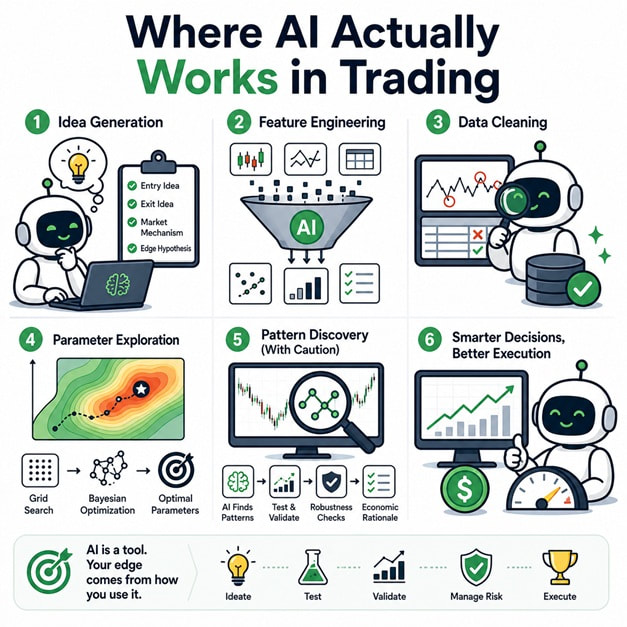
Okay, enough about the pitfalls. Let’s talk about where AI actually adds value, because it does add value - when used correctly. I use AI in my own trading and have incorporated it into how I teach strategy development. It just has to be the right tool for the right job.
6.1 Idea Generation
This is probably my favorite use of AI in trading, and it’s one of the most underused. Large language models like ChatGPT are surprisingly good at brainstorming trading concepts, explaining the intuition behind market patterns, and suggesting which market mechanisms might create an exploitable edge.
For my most recent book, “11 AI Inspired Algo Trading Strategies,” I used AI to help generate entry and exit ideas. The key word is “inspired.” AI gave me the starting point; I provided the testing, the validation, and the judgment. Many of the AI suggestions were standard or unimpressive. Some were genuinely interesting. But I never assumed an idea was good just because AI suggested it - I always tested and verified.
This is the right mental model: AI as a creative brainstorming partner, not as an oracle that hands you ready-to-trade strategies.
KEY POINT: Use AI to generate ideas, but you do the testing. Never assume an AI entry or exit is good just because it suggested it. Test it. Every time.
6.2 Feature Engineering
Feature engineering, transforming raw market data into meaningful model inputs, is time-consuming and requires real domain expertise. Machine learning tools can help in legitimate ways here.
Dimensionality reduction techniques like PCA can identify which combinations of indicators capture the most variation in price data. Feature importance scores from ensemble models like random forests can highlight which inputs have the strongest historical relationship with future returns. These tools help you build better, more robust models. Not by replacing your judgment, but by informing it.
Critical caveat: all feature selection and engineering must be done on training data only. Using full historical data for feature selection introduces look-ahead bias and will produce misleadingly good backtests. This is another one of those mistakes that’s easy to make and hard to catch.
6.3 Data Cleaning
Raw market data is messy. Errors, outliers, gaps, misuse of continuous futures contract data, inconsistencies in contract rollovers. These problems can corrupt a backtest or mislead a model. AI-powered anomaly detection tools can flag suspicious data points faster than manual review.
This is unglamorous work. But bad data is one of the fastest routes to a strategy that looks great in backtesting and falls apart in live trading. Any time you can speed up and improve data quality work, that’s real value.
6.4 Parameter Exploration
Traditional grid search optimization is computationally expensive and can miss important regions of parameter space. Bayesian optimization and other machine learning approaches to hyperparameter search can explore parameter spaces more efficiently.
Fair warning though: faster optimization makes overfitting easier, not harder. The ability to explore larger parameter spaces quickly means you can find better-looking, and more overfit, results in less time. This tool demands the same rigorous validation as any other optimization approach.
6.5 Pattern Discovery (With Caution)
Machine learning can identify complex, non-linear patterns that rule-based systems would never find. This is both the most exciting and most dangerous application of AI in trading.
Every pattern that looks promising in backtesting needs to survive walkforward analysis, out-of-sample testing, parameter sensitivity testing, and a plain-English explanation of why it should persist in the future. Most won’t survive that gauntlet. That’s not a failure of the process, that’s the process working.
Treat AI-discovered patterns as hypotheses, not conclusions. The discovery is just the beginning of your research, not the end.
6.1 Idea Generation
This is probably my favorite use of AI in trading, and it’s one of the most underused. Large language models like ChatGPT are surprisingly good at brainstorming trading concepts, explaining the intuition behind market patterns, and suggesting which market mechanisms might create an exploitable edge.
For my most recent book, “11 AI Inspired Algo Trading Strategies,” I used AI to help generate entry and exit ideas. The key word is “inspired.” AI gave me the starting point; I provided the testing, the validation, and the judgment. Many of the AI suggestions were standard or unimpressive. Some were genuinely interesting. But I never assumed an idea was good just because AI suggested it - I always tested and verified.
This is the right mental model: AI as a creative brainstorming partner, not as an oracle that hands you ready-to-trade strategies.
KEY POINT: Use AI to generate ideas, but you do the testing. Never assume an AI entry or exit is good just because it suggested it. Test it. Every time.
6.2 Feature Engineering
Feature engineering, transforming raw market data into meaningful model inputs, is time-consuming and requires real domain expertise. Machine learning tools can help in legitimate ways here.
Dimensionality reduction techniques like PCA can identify which combinations of indicators capture the most variation in price data. Feature importance scores from ensemble models like random forests can highlight which inputs have the strongest historical relationship with future returns. These tools help you build better, more robust models. Not by replacing your judgment, but by informing it.
Critical caveat: all feature selection and engineering must be done on training data only. Using full historical data for feature selection introduces look-ahead bias and will produce misleadingly good backtests. This is another one of those mistakes that’s easy to make and hard to catch.
6.3 Data Cleaning
Raw market data is messy. Errors, outliers, gaps, misuse of continuous futures contract data, inconsistencies in contract rollovers. These problems can corrupt a backtest or mislead a model. AI-powered anomaly detection tools can flag suspicious data points faster than manual review.
This is unglamorous work. But bad data is one of the fastest routes to a strategy that looks great in backtesting and falls apart in live trading. Any time you can speed up and improve data quality work, that’s real value.
6.4 Parameter Exploration
Traditional grid search optimization is computationally expensive and can miss important regions of parameter space. Bayesian optimization and other machine learning approaches to hyperparameter search can explore parameter spaces more efficiently.
Fair warning though: faster optimization makes overfitting easier, not harder. The ability to explore larger parameter spaces quickly means you can find better-looking, and more overfit, results in less time. This tool demands the same rigorous validation as any other optimization approach.
6.5 Pattern Discovery (With Caution)
Machine learning can identify complex, non-linear patterns that rule-based systems would never find. This is both the most exciting and most dangerous application of AI in trading.
Every pattern that looks promising in backtesting needs to survive walkforward analysis, out-of-sample testing, parameter sensitivity testing, and a plain-English explanation of why it should persist in the future. Most won’t survive that gauntlet. That’s not a failure of the process, that’s the process working.
Treat AI-discovered patterns as hypotheses, not conclusions. The discovery is just the beginning of your research, not the end.
7. How Professional Traders Actually Use AI

Here’s what I’ve observed consistently in how serious, professional systematic and algo traders use AI: it’s always secondary to process. Always.
The traders I’ve watched succeed over long time horizons - real, verified, long-horizon success, not a two-year backtest - have a structured, proven methodology for strategy development. AI tools plug into that methodology at specific points where they add value. They don’t replace the methodology. They never replace the methodology.
Risk Control Comes First - Always
Every professional trader I know defines risk management before they build strategies. Position sizing rules. Maximum drawdown limits. Correlation constraints between positions. Sector exposure caps. These are established before the first backtest is run. AI doesn’t change that hierarchy. A strategy using a neural network for signal generation still needs explicit, human-defined risk rules.
No AI system should be making unilateral decisions about how much capital to risk. Period.
Validate Before You Optimize
This is the sequence that separates traders who survive from traders who don’t: validate first, optimize second.
Professional traders run a strategy on out-of-sample data before touching parameters. They use walkforward analysis to simulate real-world deployment. They apply Monte Carlo simulation to understand the realistic range of outcomes. Only after passing those gates does a strategy receive optimization attention.
Most retail traders using AI do it backwards. They build a model, optimize it to look good, and then treat the optimization run as the “validation.” That produces the disasters I’ve described.
The Hybrid Approach
The most effective approach I’ve seen, and the approach I use myself, combines explicit rule-based logic with selective machine learning enhancements. The core strategy logic: entry conditions, exit conditions, market selection, regime filters. Rule-based. Fully transparent. Machine learning tools get applied at specific points: tuning position sizing, filtering low-probability signals, detecting when conditions are unfavorable for the strategy.
This hybrid approach preserves the interpretability and robustness of rule-based systems while capturing specific performance improvements from AI. It’s harder to build than a pure AI model. It’s far more likely to survive in live trading.
Portfolio Thinking
Professional systematic traders rarely bet everything on a single strategy. They operate portfolios of strategies across multiple markets, timeframes, and market mechanisms. The correlation structure of the portfolio matters enormously; a collection of low-correlated strategies with modest individual returns can produce a portfolio with much better risk-adjusted performance than any single holy grail strategy.
(Spoiler: the holy grail doesn’t exist. I learned that the hard way. Diversification, though, is the closest thing to a holy grail that I have seen in algo trading.)
AI tools can genuinely help with portfolio construction: identifying strategies with low expected correlation, optimizing allocation across strategies under uncertainty, detecting when strategies are becoming more correlated during stress periods. These are sophisticated applications that require both deep trading knowledge and technical skill. But they’re real, and they’re valuable.
The traders I’ve watched succeed over long time horizons - real, verified, long-horizon success, not a two-year backtest - have a structured, proven methodology for strategy development. AI tools plug into that methodology at specific points where they add value. They don’t replace the methodology. They never replace the methodology.
Risk Control Comes First - Always
Every professional trader I know defines risk management before they build strategies. Position sizing rules. Maximum drawdown limits. Correlation constraints between positions. Sector exposure caps. These are established before the first backtest is run. AI doesn’t change that hierarchy. A strategy using a neural network for signal generation still needs explicit, human-defined risk rules.
No AI system should be making unilateral decisions about how much capital to risk. Period.
Validate Before You Optimize
This is the sequence that separates traders who survive from traders who don’t: validate first, optimize second.
Professional traders run a strategy on out-of-sample data before touching parameters. They use walkforward analysis to simulate real-world deployment. They apply Monte Carlo simulation to understand the realistic range of outcomes. Only after passing those gates does a strategy receive optimization attention.
Most retail traders using AI do it backwards. They build a model, optimize it to look good, and then treat the optimization run as the “validation.” That produces the disasters I’ve described.
The Hybrid Approach
The most effective approach I’ve seen, and the approach I use myself, combines explicit rule-based logic with selective machine learning enhancements. The core strategy logic: entry conditions, exit conditions, market selection, regime filters. Rule-based. Fully transparent. Machine learning tools get applied at specific points: tuning position sizing, filtering low-probability signals, detecting when conditions are unfavorable for the strategy.
This hybrid approach preserves the interpretability and robustness of rule-based systems while capturing specific performance improvements from AI. It’s harder to build than a pure AI model. It’s far more likely to survive in live trading.
Portfolio Thinking
Professional systematic traders rarely bet everything on a single strategy. They operate portfolios of strategies across multiple markets, timeframes, and market mechanisms. The correlation structure of the portfolio matters enormously; a collection of low-correlated strategies with modest individual returns can produce a portfolio with much better risk-adjusted performance than any single holy grail strategy.
(Spoiler: the holy grail doesn’t exist. I learned that the hard way. Diversification, though, is the closest thing to a holy grail that I have seen in algo trading.)
AI tools can genuinely help with portfolio construction: identifying strategies with low expected correlation, optimizing allocation across strategies under uncertainty, detecting when strategies are becoming more correlated during stress periods. These are sophisticated applications that require both deep trading knowledge and technical skill. But they’re real, and they’re valuable.
8. Step-by-Step: A Better AI Trading Workflow
Here is the workflow I use in my own trading and teach in the Strategy Factory Workshop. This is not theoretical. It’s the process I’ve used to develop real strategies I trade with real money.
Step 1: Start With a Concept
Before a single line of code gets written, you ideally need a hypothesis grounded in market logic. What is the economic mechanism behind the edge you're pursuing? Why should this pattern exist? Why should it persist in the future? Having this hypothesis is great for confidence, and I like to have one, but I also create strategies where I do not 100% understand why something should work. And worse than that – sometimes the REVERSE of what I think should work actually works better!
Valid concept sources: academic research on market anomalies, observation of market microstructure behavior, logical extensions of documented edges, AI-assisted idea generation (as described in Section 6.1). Invalid concept source: "I ran the data and found a pattern on a month (or worse yet, a one day chart) of data." Pattern-first thinking on a very short time period is the fastest road to overfitting I know.
Step 2: Build a Rule-Based Model First
Before introducing AI concepts or tweaks, build the simplest possible rule-based expression of your concept. I mean the absolute simplest. Minimum rules, minimum parameters.
Why? Because this baseline does several important things. It gives you a benchmark to compare any AI enhancements against. It forces you to understand the strategy deeply before adding complexity. And it gives you something interpretable to fall back on if the AI version doesn't work out - which happens more often than not.
Step 3: Control Complexity
Before you run a single full backtest, ask yourself a hard question: how many rules, filters, and parameters does this strategy really need? The temptation at this stage is to keep adding things - - an extra filter here, one more condition there - - because each addition seems to make the logic tighter. Resist that temptation.
Set strict complexity limits before you start optimizing. Small number of parameters. Simple entry and exit logic.
Every rule you add is another opportunity for the strategy to fit the past rather than predict the future. The best strategies I've developed over 30 years are almost always simpler than I expected them to be. If the concept is sound, you don't need ten filters to make it work. If you do need ten filters to make it work, the concept probably isn't sound.
Step 4: Introduce AI Carefully
Now, and only now, is the right time to consider whether AI tools can enhance your strategy. Common high-value targets: regime detection (using clustering to identify market regimes and adjust position sizing accordingly), signal filtering (using a classifier to screen out low-probability signals), or adaptive position sizing (using a regression model to size positions based on predicted volatility or confidence).
Key rule: use limited data for all AI development. I call this Preliminary Testing, and I strictly limit the amount of data I test with. If you use too much historical data in this phase, you could taint the upcoming full dataset walkforward test. And if AI requires more historical data, it might mean the AI enhancement isn't testable yet.
Step 5: Validate Rigorously
Now run the full validation gauntlet on your rule-based baseline with any AI-enhanced improvements.
Walkforward testing: divide your historical data into windows and evaluate performance on each out-of-sample window sequentially. Monte Carlo analysis: randomly resample your trades to generate thousands of alternative equity curves and understand the realistic range of outcomes. Parameter sensitivity: test across a range of parameter values and verify that performance degrades smoothly as you move away from your chosen values. If performance does not meet your goals, that's a serious red flag.
If the strategy doesn't survive this process, it doesn't get traded. No exceptions, no "but the in-sample results look so good." The validation process exists precisely to catch strategies that look good but aren't.
Step 6: Decision Point
You've now got real information in front of you. The question is simple: did this strategy pass?
If yes, great. You have something worth trading. Put it in the portfolio, size it appropriately, and start monitoring it in live market conditions (incubation).
If no, go back to Step 1. Not Step 3. Not Step 2. Step 1. Start with a new concept. The data has told you this idea doesn't have a demonstrable edge, and no amount of tinkering with parameters or adding AI components is going to manufacture one that isn't there. The Strategy Factory process is built on volume; you develop a lot of ideas, most of them fail validation, and the ones that pass are worth trading. That's not a bug in the process. That's exactly how it's supposed to work.
Step 1: Start With a Concept
Before a single line of code gets written, you ideally need a hypothesis grounded in market logic. What is the economic mechanism behind the edge you're pursuing? Why should this pattern exist? Why should it persist in the future? Having this hypothesis is great for confidence, and I like to have one, but I also create strategies where I do not 100% understand why something should work. And worse than that – sometimes the REVERSE of what I think should work actually works better!
Valid concept sources: academic research on market anomalies, observation of market microstructure behavior, logical extensions of documented edges, AI-assisted idea generation (as described in Section 6.1). Invalid concept source: "I ran the data and found a pattern on a month (or worse yet, a one day chart) of data." Pattern-first thinking on a very short time period is the fastest road to overfitting I know.
Step 2: Build a Rule-Based Model First
Before introducing AI concepts or tweaks, build the simplest possible rule-based expression of your concept. I mean the absolute simplest. Minimum rules, minimum parameters.
Why? Because this baseline does several important things. It gives you a benchmark to compare any AI enhancements against. It forces you to understand the strategy deeply before adding complexity. And it gives you something interpretable to fall back on if the AI version doesn't work out - which happens more often than not.
Step 3: Control Complexity
Before you run a single full backtest, ask yourself a hard question: how many rules, filters, and parameters does this strategy really need? The temptation at this stage is to keep adding things - - an extra filter here, one more condition there - - because each addition seems to make the logic tighter. Resist that temptation.
Set strict complexity limits before you start optimizing. Small number of parameters. Simple entry and exit logic.
Every rule you add is another opportunity for the strategy to fit the past rather than predict the future. The best strategies I've developed over 30 years are almost always simpler than I expected them to be. If the concept is sound, you don't need ten filters to make it work. If you do need ten filters to make it work, the concept probably isn't sound.
Step 4: Introduce AI Carefully
Now, and only now, is the right time to consider whether AI tools can enhance your strategy. Common high-value targets: regime detection (using clustering to identify market regimes and adjust position sizing accordingly), signal filtering (using a classifier to screen out low-probability signals), or adaptive position sizing (using a regression model to size positions based on predicted volatility or confidence).
Key rule: use limited data for all AI development. I call this Preliminary Testing, and I strictly limit the amount of data I test with. If you use too much historical data in this phase, you could taint the upcoming full dataset walkforward test. And if AI requires more historical data, it might mean the AI enhancement isn't testable yet.
Step 5: Validate Rigorously
Now run the full validation gauntlet on your rule-based baseline with any AI-enhanced improvements.
Walkforward testing: divide your historical data into windows and evaluate performance on each out-of-sample window sequentially. Monte Carlo analysis: randomly resample your trades to generate thousands of alternative equity curves and understand the realistic range of outcomes. Parameter sensitivity: test across a range of parameter values and verify that performance degrades smoothly as you move away from your chosen values. If performance does not meet your goals, that's a serious red flag.
If the strategy doesn't survive this process, it doesn't get traded. No exceptions, no "but the in-sample results look so good." The validation process exists precisely to catch strategies that look good but aren't.
Step 6: Decision Point
You've now got real information in front of you. The question is simple: did this strategy pass?
If yes, great. You have something worth trading. Put it in the portfolio, size it appropriately, and start monitoring it in live market conditions (incubation).
If no, go back to Step 1. Not Step 3. Not Step 2. Step 1. Start with a new concept. The data has told you this idea doesn't have a demonstrable edge, and no amount of tinkering with parameters or adding AI components is going to manufacture one that isn't there. The Strategy Factory process is built on volume; you develop a lot of ideas, most of them fail validation, and the ones that pass are worth trading. That's not a bug in the process. That's exactly how it's supposed to work.
9. Common AI Trading Myths
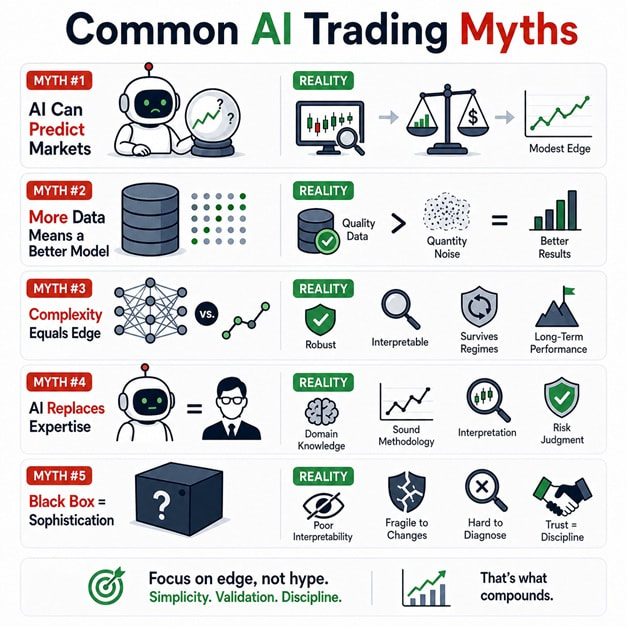
The trading world is full of myths, and AI trading has spawned its own collection. Let’s take them out and look at them directly.
Myth #1: AI Can Predict Markets
If markets were reliably predictable, arbitrage would eliminate that predictability almost instantly. What AI can sometimes do is identify statistical tendencies that translate into modest edges after costs. That’s very different from “predicting markets.” Anyone claiming their AI model reliably predicts market direction is either mistaken or selling something.
Myth #2: More Data Means a Better Model
More data can help. But quality beats quantity every time. High-quality, clean data on a small number of carefully studied markets will produce better results than a massive, noisy dataset spanning hundreds of instruments you don’t understand. And as discussed in Section 3.3, more features almost always hurt rather than help.
Myth #3: Complexity Equals Edge
This is the seductive one. A 12-layer neural network with 500,000 parameters feels more powerful than a 3-rule moving average system. It took more work to build. It looks more impressive. But in my 30+ years of trading, the consistent lesson is that simpler strategies perform better over long time horizons. Simpler is more robust. Simpler is more interpretable. Simpler survives regime changes. Complexity is usually just well-dressed overfitting.
Myth #4: AI Replaces Algo Development Expertise
This might be the most dangerous myth of all. AI tools require significant domain expertise to use correctly. You need to know which features are economically meaningful, which backtesting methodologies are valid for time series data, how to interpret results in the context of real market behavior, and how to distinguish genuine edge from spurious pattern matching.
Without that expertise, AI tools will actively help you build better-looking failures.
Myth #5: Black Box = Sophistication
Some traders have convinced themselves that opaque AI models are actually superior because they can’t be easily understood or reverse-engineered. That reasoning doesn’t hold up. The disadvantages of black-box models - poor interpretability, fragility to regime changes, inability to diagnose failure - far outweigh any theoretical security benefits for the vast majority of traders. If you can’t understand it, you can’t trust it. And if you can’t trust it, you can’t trade it through drawdowns.
Myth #1: AI Can Predict Markets
If markets were reliably predictable, arbitrage would eliminate that predictability almost instantly. What AI can sometimes do is identify statistical tendencies that translate into modest edges after costs. That’s very different from “predicting markets.” Anyone claiming their AI model reliably predicts market direction is either mistaken or selling something.
Myth #2: More Data Means a Better Model
More data can help. But quality beats quantity every time. High-quality, clean data on a small number of carefully studied markets will produce better results than a massive, noisy dataset spanning hundreds of instruments you don’t understand. And as discussed in Section 3.3, more features almost always hurt rather than help.
Myth #3: Complexity Equals Edge
This is the seductive one. A 12-layer neural network with 500,000 parameters feels more powerful than a 3-rule moving average system. It took more work to build. It looks more impressive. But in my 30+ years of trading, the consistent lesson is that simpler strategies perform better over long time horizons. Simpler is more robust. Simpler is more interpretable. Simpler survives regime changes. Complexity is usually just well-dressed overfitting.
Myth #4: AI Replaces Algo Development Expertise
This might be the most dangerous myth of all. AI tools require significant domain expertise to use correctly. You need to know which features are economically meaningful, which backtesting methodologies are valid for time series data, how to interpret results in the context of real market behavior, and how to distinguish genuine edge from spurious pattern matching.
Without that expertise, AI tools will actively help you build better-looking failures.
Myth #5: Black Box = Sophistication
Some traders have convinced themselves that opaque AI models are actually superior because they can’t be easily understood or reverse-engineered. That reasoning doesn’t hold up. The disadvantages of black-box models - poor interpretability, fragility to regime changes, inability to diagnose failure - far outweigh any theoretical security benefits for the vast majority of traders. If you can’t understand it, you can’t trust it. And if you can’t trust it, you can’t trade it through drawdowns.
10. Checklist: Evaluating Any AI Trading or Algo Trading Strategy
Whether you built it yourself or someone is trying to sell it to you, use this checklist. A strategy that can’t answer “yes” to most of these questions should not receive real capital.
If you look at a strategy, yours or someone else’s, and you can’t check most of those boxes, there’s your answer.
- Ideally, is there a logical, economic reason why this edge should exist and persist?
- Was the strategy tested on out-of-sample data that was never used during development or parameter selection?
- Does it survive walkforward analysis with acceptable performance?
- Has Monte Carlo analysis been conducted to understand the realistic distribution of outcomes?
- Is the number of model parameters reasonable relative to the amount of trades the strategy generates?
- Do you understand the strategy well enough to diagnose problems in real time?
- Has the backtest been corrected for transaction costs, slippage, and realistic fill assumptions? (HUGE IMPORTANCE)
- Are the backtest results realistic for this market, timeframe, and strategy type? (The “too good to be true” syndrome)
- Does the strategy fit within a broader portfolio rather than representing your entire trading capital?
- Is there a defined process for monitoring, diagnosing, and retiring the strategy when it stops working?
If you look at a strategy, yours or someone else’s, and you can’t check most of those boxes, there’s your answer.
11. Real-World Lessons from 30 Years of Experience

I’ve been building and trading algorithmic trading strategies since the mid-1990s. I’ve won the World Cup Trading Championship trophy three times ( #1 in 2006, and #2 in 2005 and 2007, each time with over 100% annual returns with real money). I’ve mentored hundreds of traders through my Strategy Factory Workshop. Here are the lessons that have held up across every market environment I’ve traded through.
Simpler Almost Always Wins
Early in my career, I chased complexity like everyone else. More indicators, more rules, more parameters. The backtests looked great. The live performance consistently disappointed. It took years of painful experience to accept what the data was telling me.
Today, when I develop a new strategy, I start with the absolute minimum number of rules and parameters required to express the core concept. I only add complexity when it demonstrably improves performance, as shown in walkforward testing. This discipline is uncomfortable because complex models look more impressive. It’s also the only approach that actually works over the long run.
Process Beats Tools, Every Single Time
I’ve watched the trading technology landscape evolve for three decades. Neural networks. Genetic algorithms. Expert systems. Machine learning. Deep learning. Reinforcement learning. Large language models. New tools arrive every few years with the same promise: finally, a smarter way to find edges.
The traders I’ve watched succeed consistently over long time horizons share one thing: they have a structured, disciplined development process that they follow regardless of what the latest tool promises. The tools change every few years. The process: rigorous development, rigorous validation, honest assessment of results - is what persists.
A mediocre strategy developed through a rigorous process will outperform a sophisticated strategy developed carelessly. Every time.
Overfitting Kills More Accounts Than Bad Markets
I’ve seen traders survive brutal market conditions with well-built systems. I have never seen a trader survive deploying an overfit strategy with serious capital. Never. Overfitting isn’t a minor technical problem, it’s the primary cause of trading system failure. Period.
Every tool you add to your development process needs to be evaluated through this lens: does this increase or decrease my overfitting risk? If the honest answer is “it increases the risk,” you need exceptionally strong validation before proceeding.
Discipline Through Drawdowns Is Non-Negotiable
Every strategy, no matter how well-built, will experience drawdowns. The critical skill is distinguishing between a strategy that’s in a normal drawdown and one that’s actually broken. That distinction requires understanding your system well enough to have genuine confidence in its statistical properties.
Traders with black-box AI systems often can’t maintain that discipline because they can’t make that distinction. They abandon good strategies too early and hold bad ones too long. The interpretability that comes from transparent development isn’t just nice to have. It’s essential for the psychological side of systematic trading.
Simpler Almost Always Wins
Early in my career, I chased complexity like everyone else. More indicators, more rules, more parameters. The backtests looked great. The live performance consistently disappointed. It took years of painful experience to accept what the data was telling me.
Today, when I develop a new strategy, I start with the absolute minimum number of rules and parameters required to express the core concept. I only add complexity when it demonstrably improves performance, as shown in walkforward testing. This discipline is uncomfortable because complex models look more impressive. It’s also the only approach that actually works over the long run.
Process Beats Tools, Every Single Time
I’ve watched the trading technology landscape evolve for three decades. Neural networks. Genetic algorithms. Expert systems. Machine learning. Deep learning. Reinforcement learning. Large language models. New tools arrive every few years with the same promise: finally, a smarter way to find edges.
The traders I’ve watched succeed consistently over long time horizons share one thing: they have a structured, disciplined development process that they follow regardless of what the latest tool promises. The tools change every few years. The process: rigorous development, rigorous validation, honest assessment of results - is what persists.
A mediocre strategy developed through a rigorous process will outperform a sophisticated strategy developed carelessly. Every time.
Overfitting Kills More Accounts Than Bad Markets
I’ve seen traders survive brutal market conditions with well-built systems. I have never seen a trader survive deploying an overfit strategy with serious capital. Never. Overfitting isn’t a minor technical problem, it’s the primary cause of trading system failure. Period.
Every tool you add to your development process needs to be evaluated through this lens: does this increase or decrease my overfitting risk? If the honest answer is “it increases the risk,” you need exceptionally strong validation before proceeding.
Discipline Through Drawdowns Is Non-Negotiable
Every strategy, no matter how well-built, will experience drawdowns. The critical skill is distinguishing between a strategy that’s in a normal drawdown and one that’s actually broken. That distinction requires understanding your system well enough to have genuine confidence in its statistical properties.
Traders with black-box AI systems often can’t maintain that discipline because they can’t make that distinction. They abandon good strategies too early and hold bad ones too long. The interpretability that comes from transparent development isn’t just nice to have. It’s essential for the psychological side of systematic trading.
12. Conclusion: AI Is a Tool, Not a Solution
Let me leave you with the clearest possible summary.
AI is a set of powerful tools with real, specific applications in algo trading strategy development. Used correctly, within a disciplined process, AI can help you generate better ideas, build more refined models, and work with complex data more efficiently. That value is genuine.
But AI is not a solution to the fundamental challenge of trading: finding real, persistent edges in competitive, intelligent markets. That challenge requires domain expertise, rigorous methodology, intellectual honesty about your results, and patience to validate before deploying capital. No AI tool substitutes for those things. Not now, and not anytime soon in my opinion.
Most traders approaching AI algorithmic trading, expecting it to shortcut the hard work, will be disappointed. They’ll build systems that look brilliant in backtesting and fail in live trading. They’ll confuse complexity with edge, pattern matching with insight, and backtest performance with genuine predictive ability.
The traders who succeed with AI will be the ones who treat it as one component (or tool) of a rigorous process, not a replacement for it. They’ll use AI where it genuinely adds value, apply the same demanding validation standards to AI-enhanced strategies as they do to everything else, and keep asking the uncomfortable question: “is this edge real, or does it just look real?”
Real edge comes from process. It always has. AI doesn’t change that. It just adds some powerful new tools that require a lot of care to use well.
AI is a set of powerful tools with real, specific applications in algo trading strategy development. Used correctly, within a disciplined process, AI can help you generate better ideas, build more refined models, and work with complex data more efficiently. That value is genuine.
But AI is not a solution to the fundamental challenge of trading: finding real, persistent edges in competitive, intelligent markets. That challenge requires domain expertise, rigorous methodology, intellectual honesty about your results, and patience to validate before deploying capital. No AI tool substitutes for those things. Not now, and not anytime soon in my opinion.
Most traders approaching AI algorithmic trading, expecting it to shortcut the hard work, will be disappointed. They’ll build systems that look brilliant in backtesting and fail in live trading. They’ll confuse complexity with edge, pattern matching with insight, and backtest performance with genuine predictive ability.
The traders who succeed with AI will be the ones who treat it as one component (or tool) of a rigorous process, not a replacement for it. They’ll use AI where it genuinely adds value, apply the same demanding validation standards to AI-enhanced strategies as they do to everything else, and keep asking the uncomfortable question: “is this edge real, or does it just look real?”
Real edge comes from process. It always has. AI doesn’t change that. It just adds some powerful new tools that require a lot of care to use well.
Want to Learn the Right Way to Build AI Trading Strategies and Algo Strategies?
If this article resonated with you, here’s the next step.
Everything I’ve described in this article - the rigorous development process, the walkforward testing, the Monte Carlo analysis, the hybrid AI approach, the portfolio construction methodology - is exactly what I teach in the Strategy Factory Workshop.
This is my comprehensive, step-by-step program for building a personal portfolio of rigorously validated algorithmic trading strategies. It’s built around the same methodology I’ve used in my own trading and competition results. Not theory. Not hype. The actual process.
Students learn how to use AI and machine learning tools appropriately, at the right points in the right process, with proper validation, in ways that actually improve real-world performance. They come away with both the skills and the systems to trade systematically and professionally.
If you’re serious about algo trading and tired of chasing the next shiny object, visit KJTradingSystems.com to learn more about the Strategy Factory Workshop. The market will always reward genuine edge over wishful thinking.
Let’s build the real thing.
Everything I’ve described in this article - the rigorous development process, the walkforward testing, the Monte Carlo analysis, the hybrid AI approach, the portfolio construction methodology - is exactly what I teach in the Strategy Factory Workshop.
This is my comprehensive, step-by-step program for building a personal portfolio of rigorously validated algorithmic trading strategies. It’s built around the same methodology I’ve used in my own trading and competition results. Not theory. Not hype. The actual process.
Students learn how to use AI and machine learning tools appropriately, at the right points in the right process, with proper validation, in ways that actually improve real-world performance. They come away with both the skills and the systems to trade systematically and professionally.
If you’re serious about algo trading and tired of chasing the next shiny object, visit KJTradingSystems.com to learn more about the Strategy Factory Workshop. The market will always reward genuine edge over wishful thinking.
Let’s build the real thing.
If you enjoyed this article, please share it!
HTML Comment Box is loading comments...

About The Author: Kevin Davey is an award winning private futures, forex and commodities trader. He has been trading for over 30 years. Three consecutive years Kevin achieved over 100% annual returns in a real time, real money, year long trading contest, finishing in first or second place each of those years.
Kevin is the author of the highly acclaimed book "Building Algorithmic Trading Systems: A Trader's Journey From Data Mining to Monte Carlo Simulation to Live Trading" (Wiley 2014) and 5 other best selling algo trading books, all available on Amazon. Kevin teaches the award winning Strategy Factory workshop, ideal for aspiring algo traders.
Copyright, Kevin Davey and KJ Trading Systems. All Rights Reserved. Reprint of above article is permitted, as long as the About The Author information is included.
Kevin is the author of the highly acclaimed book "Building Algorithmic Trading Systems: A Trader's Journey From Data Mining to Monte Carlo Simulation to Live Trading" (Wiley 2014) and 5 other best selling algo trading books, all available on Amazon. Kevin teaches the award winning Strategy Factory workshop, ideal for aspiring algo traders.
Copyright, Kevin Davey and KJ Trading Systems. All Rights Reserved. Reprint of above article is permitted, as long as the About The Author information is included.